What Is Inside a Transformer? A Look at Its Core Parts
Published: Author: JellyDai
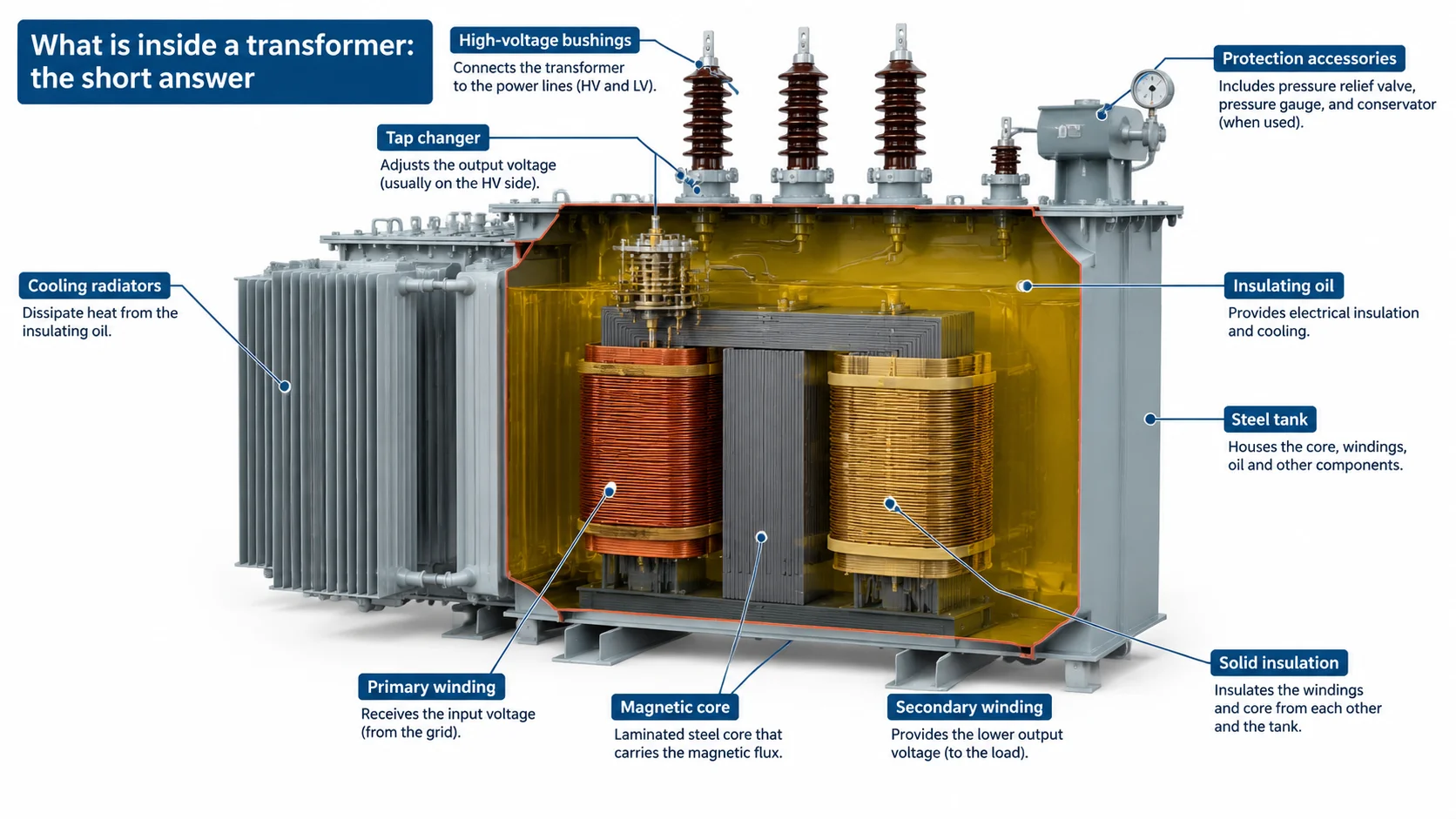
A distribution transformer looks like a sealed steel box on a pole or a pad, but inside it holds a small number of parts that do all the electrical work: a magnetic core, a primary winding, a secondary winding, and the insulation that separates them. In an oil-immersed unit, those parts sit in a tank of insulating oil, and external accessories connect, cool, and protect them.
This guide explains each part from the inside out, so you can read a nameplate or a specification sheet with a clear picture of what is actually in the tank.
What is inside a transformer: the short answer
Most distribution transformers contain the same basic assembly:
a magnetic core built from thin steel laminations;
a primary (high-voltage) winding and a secondary (low-voltage) winding ;
solid insulation in the form of enamel, paper, and pressboard between turns, between windings, and to earth;
a steel tank and, in oil-immersed designs, insulating oil ;
bushings that carry the windings out through the tank;
a tap changer for adjusting the turns ratio; and
protection accessories such as a conservator, breather, Buchholz relay, and pressure-relief device on larger oil-filled units.
Dry-type transformers keep the same core-and-winding idea but replace the oil with solid cast-resin or impregnated insulation and use air for cooling.
The magnetic core
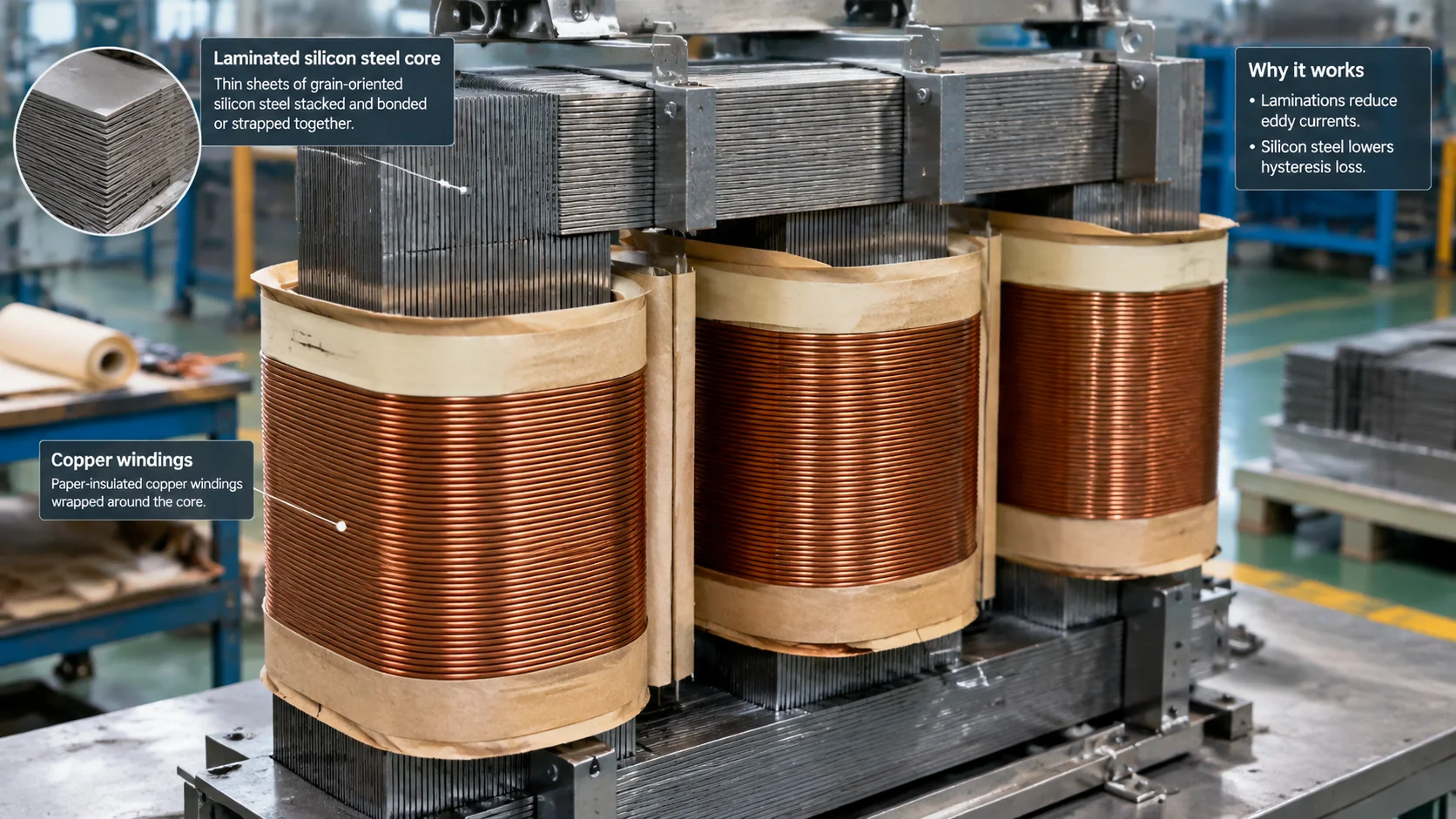
The core is the closed loop of steel that carries the magnetic flux linking the two windings. It is almost never a single solid block. Instead it is built from many thin sheets of grain-oriented silicon steel, often called transformer steel, stacked together and either bonded with resin or held with steel straps.
Laminating the core is not cosmetic. A changing magnetic flux induces circulating currents, called eddy currents, in any conductor it passes through. A solid steel core would let those currents flow freely and produce heat. Thin, individually insulated laminations break that path and cut the loss sharply. Silicon steel is chosen because it also has low hysteresis loss, the energy lost each time the magnetic field reverses.
Together, hysteresis and eddy-current losses form the no-load, or iron, loss of a transformer. That loss is present whenever the unit is energised, even with nothing connected to the secondary, which is why core design matters so much for a distribution transformer that stays energised around the clock. Typical distribution transformers reach efficiencies of roughly 98 to 99 percent.
The windings
The windings are the coils that carry current. The high-voltage winding connects to the supply or the distribution line; the low-voltage winding feeds the load. Because both windings link the same core flux, the ratio of their turns sets the ratio of their voltages, so a winding with ten times as many turns produces ten times the voltage.
Windings are usually made from enamel-coated copper wire. A low-voltage secondary that carries heavy current may instead use a thick ribbon or strip of copper or aluminium. The conductors are insulated with resin-impregnated paper and are kept apart from each other and from the core by shaped barriers.
The mechanical arrangement matters as much as the conductor. A short circuit can push very large forces through the windings, so the winding structure is built to hold its shape under that stress rather than relying on insulation alone.
Insulation
Solid insulation is what stops a transformer from short-circuiting itself. It works at three levels: enamel or film on each conductor, paper and pressboard between turns and between windings, and clearances that hold live parts away from the earthed core and tank. In an oil-immersed transformer the oil becomes part of that insulation system, filling the spaces that solid insulation cannot reach and soaking into the paper.
Insulation is also the part most sensitive to heat and moisture. That is why manufacturing includes a drying and vacuum stage before oil is introduced: even a small amount of residual moisture can lead to corona discharge and eventually to electrical breakdown under load.
The tank, oil, and cooling system
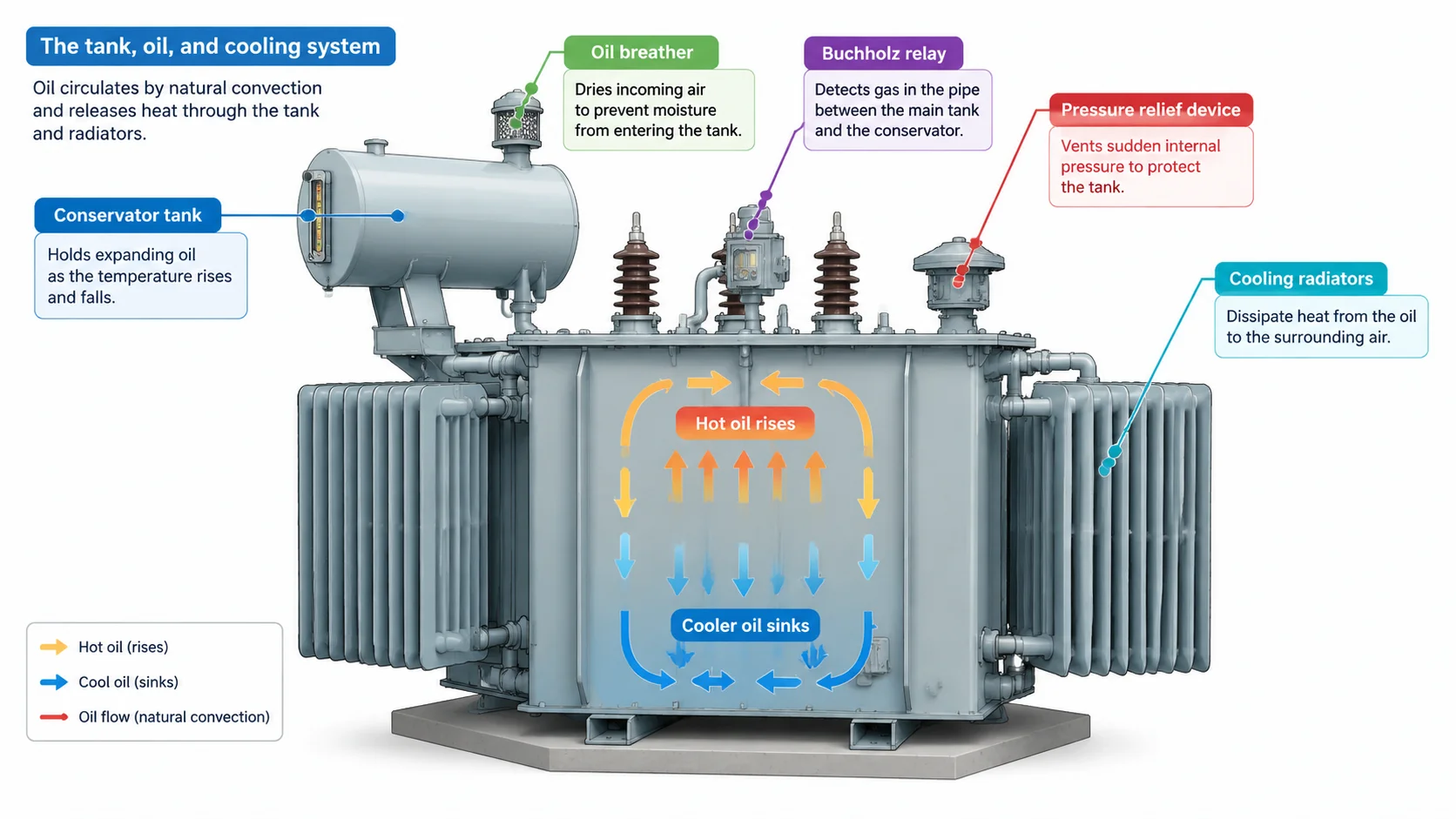
In an oil-immersed transformer the core and windings are lowered into a sealed, powder-coated steel tank, which is then filled with insulating oil. The tank does more than contain the assembly. It provides the mechanical frame, the oil volume, and the surface area through which heat finally leaves the unit.
What the oil does
Transformer oil has two jobs at once: it insulates and it cools. It must hold high dielectric strength and thermal conductivity and keep those properties after long periods at high temperature. A common mineral oil has a flash point above 140 °C, a pour point below −40 °C, and a dielectric breakdown strength above 28 kV at standard test conditions.
Radiators and cooling modes
The oil removes heat from the windings and core by natural convection, rises, and gives that heat up through the tank walls and any radiators fitted to them. Larger units add cooling fans, oil pumps, or oil-to-water heat exchangers when natural circulation is not enough. Oil quality is not permanent, so oil in larger transformers is sampled and tested periodically to confirm it is still fit for service.
Bushings and terminal connections
Bushings are the insulated terminals that pass conductors through the tank wall or cover so the windings can connect to the outside network. A distribution transformer usually has high-voltage bushings on top and low-voltage terminals on the side. Bushing insulation must withstand the full voltage to earth plus transient overvoltages from switching and lightning, so a surge arrester is often mounted close to the high-voltage bushing. Because a bushing joins two environments, it is also a common entry point for moisture and a common source of oil leaks.
The tap changer
A tap changer selects different connection points, called taps, along a winding so the turns ratio, and therefore the output voltage, can be adjusted. Off-circuit tap changers must be set with the transformer de-energised, usually once at installation, to compensate for the local supply voltage. On-load tap changers change taps while the transformer is energised and are more common on larger power transformers. A typical on-load unit offers roughly ±10 percent adjustment in small steps.
Protection and monitoring accessories
The parts below are mounted outside the core-and-winding assembly but directly affect how it behaves in service:
Conservator tank — an overhead oil reservoir that gives the oil room to expand and contract as it heats and cools while keeping the main tank full.
Oil breather — a container of desiccant, usually silica gel, that dries the air drawn into the conservator as the oil level falls.
Buchholz relay — fitted in the pipe between the main tank and the conservator; it alarms on slow gas accumulation and trips a circuit breaker when an arc pushes oil through it rapidly.
Pressure-relief device — vents a sudden pressure rise inside the tank. Transformers without a conservator often use a sudden-pressure relay for the same purpose.
Temperature and monitoring devices — oil and winding temperature indicators, and on larger units dissolved-gas monitoring, which flags internal faults before they become failures.
Oil-immersed and dry-type: what changes inside
The core, windings, and bushings are broadly similar in both families. The main difference is the insulation and cooling medium. Oil-immersed transformers place the assembly in an oil-filled sealed tank, which suits outdoor distribution duty and continuous loading. Dry-type transformers cast or impregnate the windings in solid insulation and cool them with air, removing the liquid entirely. That removes the fire risk and contamination concerns of oil but generally limits the ratings and short-term overload capability a dry unit can handle.
Part
Oil-immersed transformer
Dry-type transformer
Core and windings
Yes, immersed in the tank
Yes, exposed in an enclosure
Main insulation
Insulating oil plus paper and pressboard
Cast resin or impregnated solid insulation
Cooling
Oil circulation, tank and radiators, optional fans or pumps
Air circulation, often fan-assisted
Typical installation
Outdoor and pad-mounted distribution
Indoor rooms, buildings, and fire-sensitive areas
Frequently asked questions
What are the main parts inside a transformer?
A magnetic core, a primary winding, a secondary winding, and the insulation between them. An oil-immersed transformer adds insulating oil, a sealed tank, bushings, a tap changer, and protection accessories such as a conservator and Buchholz relay.
Is there water inside a transformer?
No. Moisture is removed during manufacture by drying and vacuum treatment, and the oil is kept dry in service. Water inside the insulation would reduce its dielectric strength and can lead to arcing, which is why larger transformers are sealed and their oil tested periodically.
Do all transformers contain oil?
No. Dry-type transformers use cast-resin or impregnated solid insulation and air cooling instead of oil. Oil-immersed units remain the common choice for outdoor distribution because the oil both insulates and carries heat away efficiently.
Instrument transformers use the same core-and-winding principle, but they are scaled to produce a small, standard secondary output that measuring and protection devices can read safely. They are metering and protection components rather than the transformers that supply a building.
Choosing a transformer you can inspect with confidence
Knowing what is inside a transformer makes it easier to ask the right questions before you buy: what core material is used, how the windings are insulated, what cooling mode is specified, and which protection accessories are included for the site.
SAGE Power supplies both oil-immersed and dry-type distribution transformers, including the S13 10 kV low-loss oil-immersed transformer, and can combine them with medium-voltage switchgear and low-voltage equipment into prefabricated substations. To match a core and winding configuration to your load, share your capacity, voltage ratio, and site conditions with the team and request a quote.
A power substation is where the grid changes voltage and routes electricity between transmission and distribution. Here is what a substation does, what is inside it, and how the main types differ.
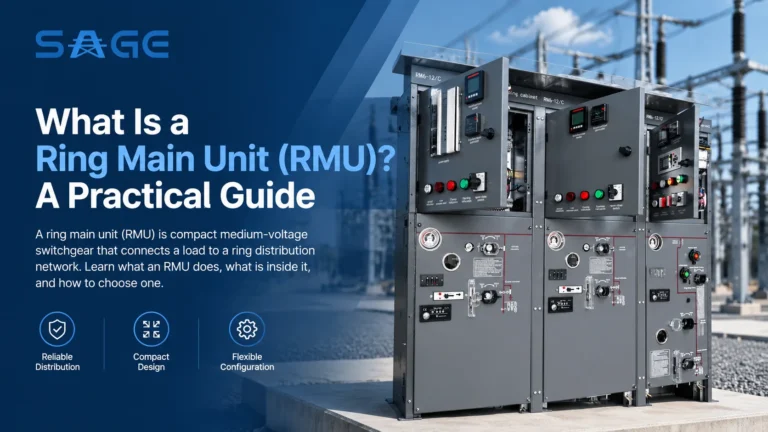
A ring main unit (RMU) is compact medium-voltage switchgear that connects a load to a ring distribution network. Learn what an RMU does, what is inside it, and how to choose one.