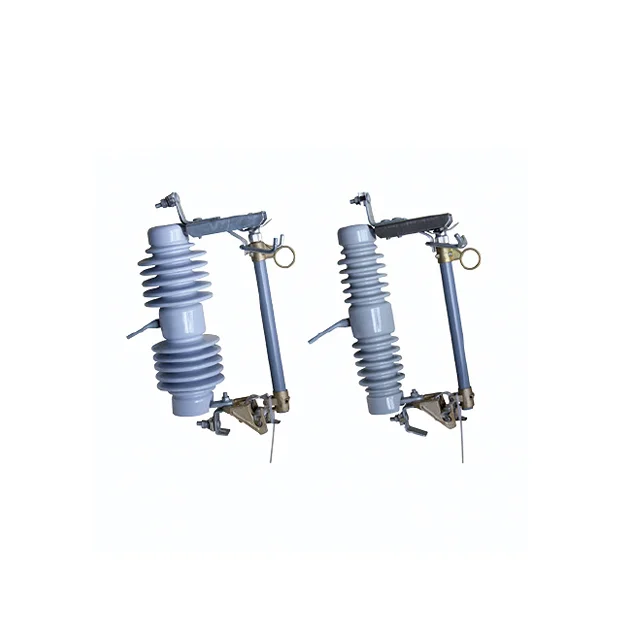
Drop-Out Fuse Cutout Buying Guide | Rating, Insulator and Fuse Link
1. Match the cutout to the line voltage and load
Confirm the system voltage, the maximum load current and the fault level at the tapping point. A 100A cutout suits small distribution transformers and branch lines; a 200A cutout is used for larger transformers and main line sections. The voltage rating must be at least the highest system voltage, not the nominal value.
| Rating | Typical use | Fuse link range |
|---|---|---|
| 100A, 11-15kV | Distribution transformers up to about 100kVA | 6A to 100A |
| 200A, 11-15kV | Larger transformers and line sections | 100A to 200A |
| 100A, 24-35kV | MV overhead lines and rural distribution | 6A to 100A |
2. Choose the fuse link rating
The link must carry the transformer magnetising inrush without nuisance operation, protect the transformer against overload and clear secondary faults, and coordinate with the upstream recloser or breaker. Use the transformer kVA, the primary voltage and the link time-current curve, and allow for ambient temperature and solar heating of the cutout.
3. Select polymer or porcelain insulation
Polymer housings are lighter, resist UV and pollution, and are less likely to shatter. Porcelain is traditional and widely accepted where the specification still calls for it. In coastal, cement, chemical or heavily polluted areas, polymer with a higher creepage distance is the safer choice.
4. Check mounting, creepage and pollution level
Confirm the mounting bracket, the phase spacing and the operating angle. The cutout must open fully without touching adjacent phases or the structure. Check the creepage distance against the site pollution level, and confirm the line and load terminal type so the conductor fits without an adapter.
5. Confirm tests and spare parts
Routine checks cover contact resistance, power frequency withstand and mechanical operation. Ask for the matching fuse link, the spare fuse holder and the operating stick, because a cutout without the correct link cannot protect the transformer. Confirm the marking and the link curve reference on the nameplate.
6. RFQ checklist
- System voltage, load current and fault level
- Transformer kVA and required fuse link rating
- Polymer or porcelain insulator
- Creepage distance and pollution level
- Mounting bracket and terminal type
- Spare links, holders and operating stick
- Quantity, destination and delivery date
Send the line and transformer data and the cutout and link can be matched in one round.