A ring main unit (RMU) is a compact, factory-assembled set of medium-voltage switchgear that connects a load — usually a distribution transformer — to a ring-shaped distribution network. In one enclosure it combines the switches needed to feed that load from either direction on the ring, together with the protection device that clears a fault on the transformer feeder.
That is the short answer to “what is a ring main unit.” The rest of this guide explains how an RMU works, what is inside it, how the insulation technologies differ, and what to check when you specify one for a project.
What Is a Ring Main Unit?
The name comes from the ring main: a medium-voltage distribution circuit in which cables run out from a source and loop back to it, forming a closed ring rather than a single radial path. Every load point on that ring needs a way to connect to the loop from either side and to isolate itself without shutting down the rest of the network. A ring main unit provides exactly that.
In the standard description of the equipment, an RMU is a metal-enclosed, factory-assembled unit that contains two switches able to connect the load to either or both main conductors, plus a fusible switch or circuit breaker that feeds a distribution transformer. Ring main cables enter and leave the cabinet, and the unit is typically installed outdoors or in a dedicated switchroom.
In day-to-day use the term is applied loosely. Some engineers call any compact medium-voltage switchgear an RMU, but the ring connection function is what defines the category. If you are comparing options across a range of ring main units, that distinction matters: an RMU is sized and configured around feeding a single load point, not around switching many feeders at once.
How a Ring Main Unit Fits Into a Ring Network
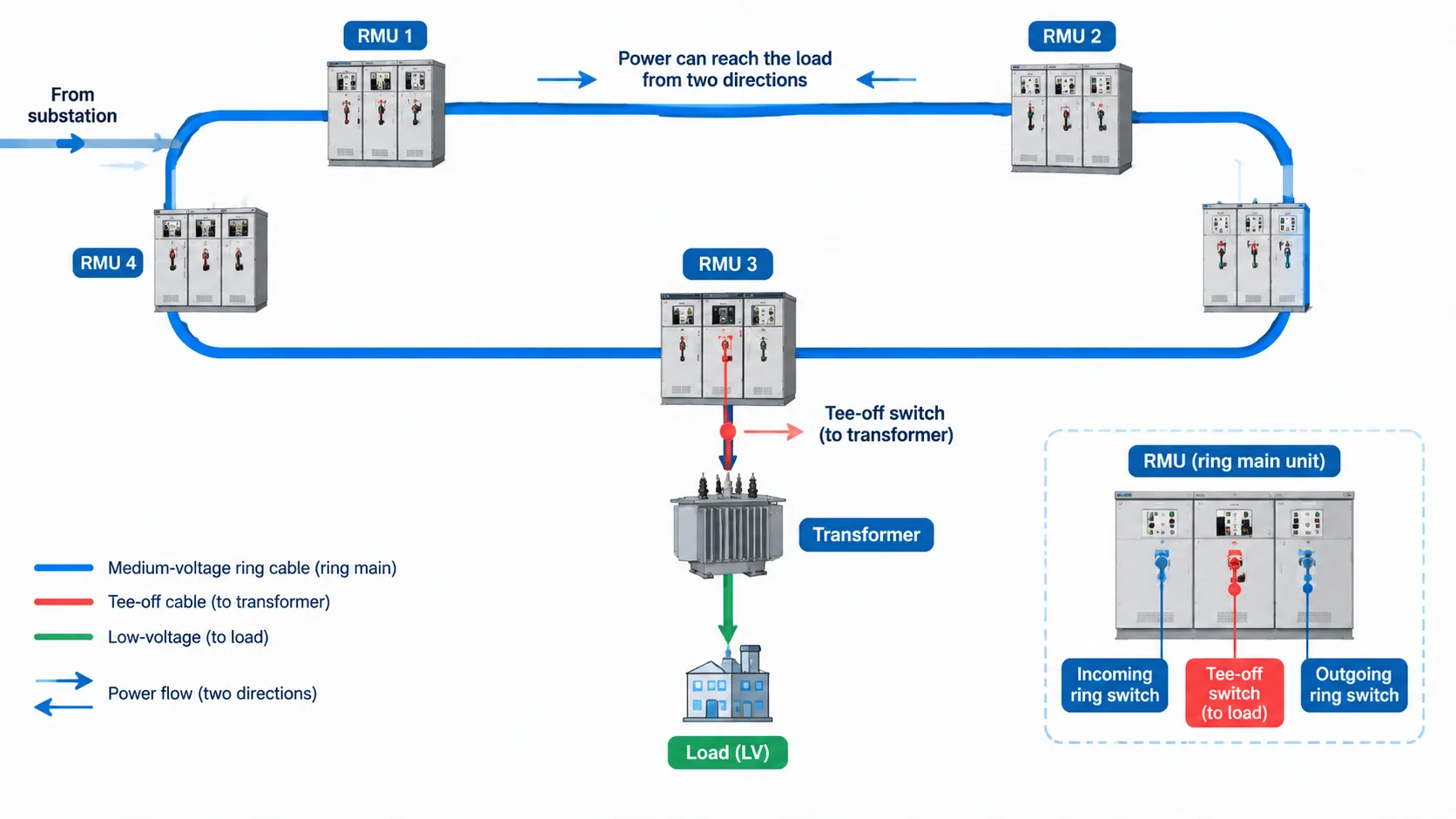
In a ring network, power can reach a load from two directions. If one cable section is damaged or taken out for maintenance, operators isolate that section and re-close the ring so that supply continues from the other side. The point left open during normal running is the open point, and the ability to move it is what makes the ring resilient.
An RMU implements that logic at the load point. A typical unit has:
a ring switch on the incoming side , and
a ring switch on the outgoing side , so the ring can continue past the load, and
a tee-off switch that connects the load, normally through a fuse or circuit breaker.
To isolate the load, an operator opens the tee-off switch, then the two ring switches. Because the ring switches are load-break devices, they can open the cable’s charging and load current without an upstream breaker tripping, which is why ring-main work is usually done locally and quickly.
Ring versus radial layout
Property
Ring network with RMUs
Radial network
Supply paths to a load
Two
One
Effect of one cable fault
Isolate the section; keep the rest supplied
All downstream loads lose supply
Typical use
Urban and industrial distribution where continuity matters
Simple, lower-cost feeders and spurs
Switching equipment
RMU with two ring switches plus tee-off
Single switch or switch-fuse
What Is Inside a Ring Main Unit?
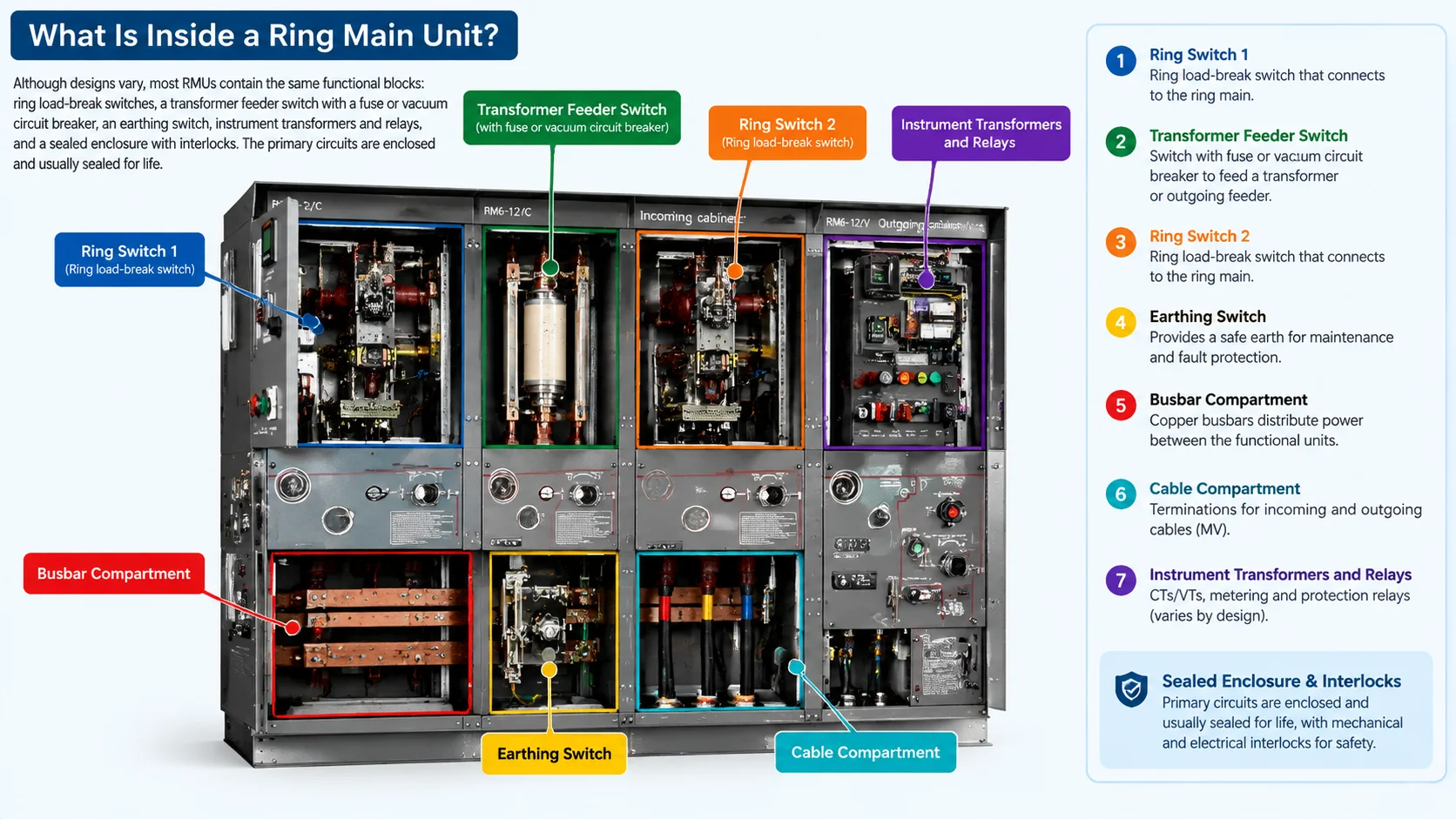
Although designs vary, most RMUs contain the same functional blocks. The primary circuits are enclosed and usually sealed for life, which is why the enclosure rather than the components is the first thing to understand.
Ring (load-break) switches
These open and close the cable loop. They are load-break capable but do not normally interrupt fault current, so they are used for normal switching and isolation. In many gas-insulated designs both ring switches and the tee-off share one sealed gas tank.
Transformer feeder switch and protection
The tee-off to the transformer is protected in one of two ways. A switch-fuse combination uses current-limiting fuses to clear faults, which is simple and cost-effective at lower ratings. A vacuum circuit breaker with a relay clears fault current and resets electrically, which suits higher fault levels and remote or automated operation.
Earthing switch
An earthing switch connects the cable or busbar to earth before work begins. Mechanical interlocks normally prevent it from closing while the associated switch is closed, and prevent the switch from closing while the earthing switch is engaged — one of the main safety features of an RMU.
Instrument transformers and relays
Voltage and current transformers feed metering, indication and protection. Modern RMUs increasingly include self-powered protection relays, earth-fault indication and remote signalling, which allows a utility to see and operate the unit from a control centre.
Enclosure and interlocks
The enclosure determines the environmental rating. Indoor units are commonly rated IP4X for protection against solid objects, while outdoor-rated versions add higher water protection such as IP55. Interlocks between the ring switches, tee-off and earthing switch are what make the unit safe to operate with the panel closed.
Insulation Types: SF6, Solid and SF6-Free
The insulation medium is often the deciding factor in a specification, because it affects size, maintenance, cost and environmental reporting.
Type
How it insulates
Typical strengths
Considerations
SF6 gas-insulated
Live parts sealed in a tank filled with sulfur hexafluoride gas
Very compact; mature, well-proven; maintenance-free sealed design
SF6 is a potent greenhouse gas, so handling and end-of-life rules apply
Solid-insulated
Busbars and connections cast in epoxy or similar solid insulation
No insulating gas to manage; robust; easy to inspect
Larger and heavier than gas-insulated units at the same rating
SF6-free gas-insulated
Sealed gas tank using an alternative insulating gas, often with solid insulation
Compact like SF6, without the SF6 environmental burden
Newer technology; confirm availability and local approval
For years SF6 was the default because it allows a very small, sealed enclosure. Tightening regulation of fluorinated greenhouse gases in the EU and elsewhere has since pushed manufacturers and utilities toward alternatives. That is why product ranges now offer three insulation options side by side — for example, SAGE Power supplies an SF6 gas-insulated RMU range, a 12 kV SF6-free gas-insulated RMU, and solid-insulated switchgear for projects that must avoid SF6 entirely.
Typical Ratings and What They Mean
RMUs are built for secondary distribution, the part of the network between the primary substation and the customer. Ratings cluster in a fairly narrow band, and knowing what each number controls makes a specification easier to review.
Rating
Common values
What it controls
Rated voltage
12 kV, 24 kV
The system voltage class the unit may be connected to
Rated current
630 A, 1250 A
The continuous load the ring and tee-off can carry
Short-time withstand current
20 kA or 25 kA for 3 s
The fault current the busbar and enclosure can survive while protection clears
Peak withstand current
50 kA
The first-cycle peak of the fault current
Power-frequency withstand
42 kV for 1 min
Insulation strength verified by routine dielectric testing
Lightning impulse withstand
75 kV
Insulation strength against impulse overvoltages
Enclosure protection
IP4X indoor / IP55 outdoor
Protection against solid objects, dust and water at the installed location
As an example of how these come together in a real product, the SF6 gas-insulated ring main unit for 12 kV and 24 kV secondary distribution is offered at 630 A or 1250 A, with 25 kA for 3 s and 50 kA peak, cabinet widths from 375 mm, and indoor or outdoor protection options. Always confirm the ratings against the actual network fault level and load rather than assuming a standard value.
Where Ring Main Units Are Used
Urban and residential distribution — compact loops serving housing complexes and city blocks where space is limited.
Commercial buildings — offices, shopping centres and hotels that need continuity of supply.
Industrial facilities — plants, mines and manufacturing sites with medium-voltage distribution rooms.
Renewable energy — wind farms and solar plants, where compact switching is used to collect and feed power.
Infrastructure — airports, railways, tunnels and hospitals that cannot tolerate long outages.
Compact substations — prefabricated and box-type substations, where the RMU is often integrated with the transformer.
Ring Main Unit vs Metal-Clad Switchgear
An RMU and a metal-clad switchgear cabinet are both medium-voltage switchgear, but they are built for different jobs. Choosing the wrong one usually shows up as either wasted space or an underrated installation.
Factor
Ring main unit
Metal-clad switchgear
Primary role
Feed one load point from a ring
Switch and protect many feeders in one lineup
Switching device
Load-break switches plus fuse or vacuum breaker
Draw-out vacuum circuit breakers on each feeder
Footprint
Very compact, often 375 mm per functional unit
Larger; requires a switchroom with front and rear access
Maintenance model
Sealed for life; minimal routine maintenance
Breakers withdrawn and serviced periodically
Typical fit
Secondary distribution, small substations
Primary distribution, large plants, utility substations
Where a project needs a full lineup of draw-out breakers rather than a ring tee-off, a metal-clad switchgear cabinet is the more appropriate choice. Many installations use both: metal-clad switchgear at the main substation and RMUs further out on the ring.
How to Choose a Ring Main Unit
Work through these points before requesting quotations, because each one changes the enclosure, the cost and the lead time.
System voltage and rated current. Match the RMU to the network voltage class and the maximum continuous load on the ring and tee-off.
Fault level. Confirm the prospective short-circuit current so the short-time withstand and protection ratings are adequate.
Number of ways and extensibility. Decide whether the unit is fixed or must be extended later with side or top extension.
Insulation technology. Choose SF6, solid or SF6-free according to space, environmental policy and local approval.
Indoor or outdoor. Set the enclosure protection rating to suit the installed environment.
Protection and automation. Specify relays, earth-fault indication and remote signalling if the unit will be monitored or operated remotely.
Standards and testing. Require type-tested equipment to the relevant medium-voltage switchgear standard, such as IEC 62271-200, and ask for the test certificates.
Site conditions. Confirm ambient temperature range and altitude, since both can limit the standard rating.
Frequently Asked Questions
What does RMU stand for?
RMU stands for ring main unit — a compact, metal-enclosed set of medium-voltage switchgear used at load points on a ring distribution network.
Is a ring main unit a circuit breaker?
Not exactly. An RMU is an assembly that contains switches and a protective device. That protective device may be a circuit breaker, but in many units it is a fuse-switch combination instead. The ring switches themselves are load-break switches, not circuit breakers.
What voltage does a ring main unit operate at?
RMUs are used for medium-voltage secondary distribution, most commonly at 12 kV and 24 kV. The same concept also appears in pad-mounted equipment elsewhere, but the equipment described here is built for the 12 kV to 24 kV class.
Can a ring main unit be installed outdoors?
Yes. Outdoor-rated units are available with higher enclosure protection, such as IP55, and a corrosion-resistant enclosure. Indoor units generally use a lower protection rating such as IP4X.
How much maintenance does an RMU need?
Because the primary circuit is sealed, routine maintenance is minimal — seals, interlocks and indications are typically checked rather than internal parts. Maintenance intervals still depend on the manufacturer’s instructions, the environment and how often the switches operate.
SF6 or SF6-free: which should I choose?
Choose SF6 when you need the smallest footprint and the technology is accepted locally, and choose SF6-free or solid insulation when environmental policy, reporting or local rules favour avoiding SF6. Both deliver sealed, compact switching; the trade-off is mainly environmental and, in some cases, physical size.
Key Takeaways
A ring main unit is compact medium-voltage switchgear that connects a load to a ring network and lets that load be isolated without interrupting the rest of the ring. Two ring switches, a protected tee-off, an earthing switch and a sealed enclosure make up the core of the design, and the insulation technology — SF6, solid or SF6-free — is usually the main specification decision.
Once you know the system voltage, load, fault level and number of ways, the ratings and configuration fall into place. If you are specifying an RMU and want help matching it to a network, contact the SAGE Power team with your project details.
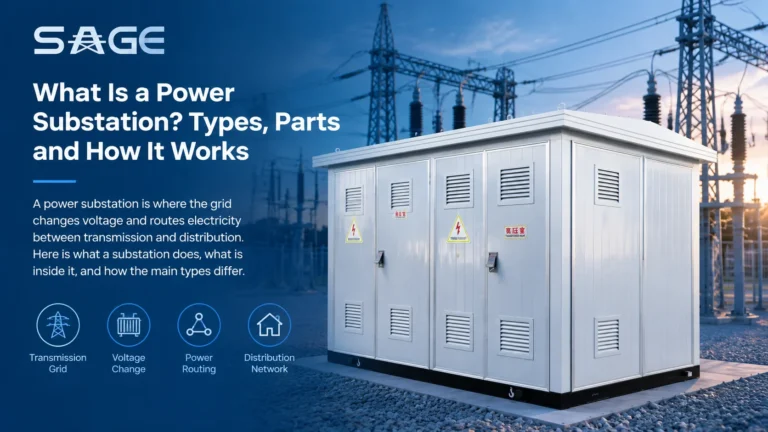
A power substation is where the grid changes voltage and routes electricity between transmission and distribution. Here is what a substation does, what is inside it, and how the main types differ.
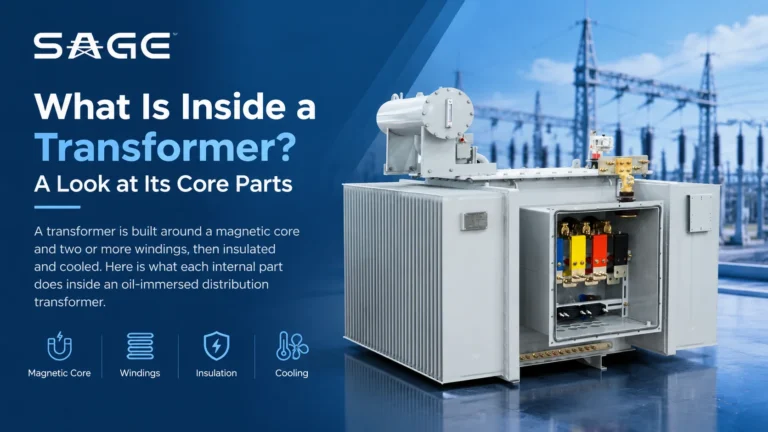
A transformer is built around a magnetic core and two or more windings, then insulated and cooled. Here is what each internal part does inside an oil-immersed distribution transformer.